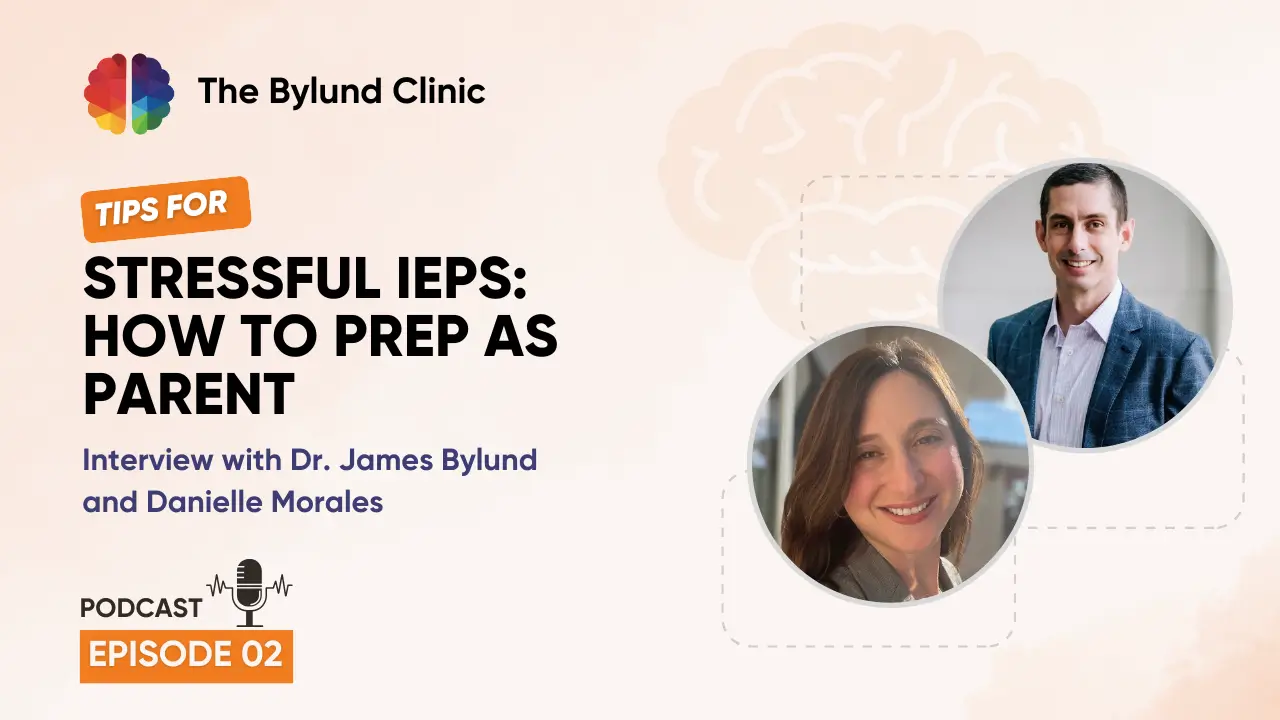
Interview with Dr. James Bylund & Danielle Morales


Welcome
At The Bylund Clinic, one of the most common questions we hear from parents, educators, and IEP teams is:
“Is this a mild intellectual disability (ID) or a specific learning disability (SLD)?”
In this episode of our podcast, Dr. James Bylund and Danielle Morales take a closer look at both terms. They explain what each one means, how they’re identified, and most importantly, why the difference matters. If your child is struggling in school and you’re not sure why, this conversation will help you understand what might be happening and what steps to take next.
Let’s Start With IQ (and What It Actually Tells Us)
A lot of decisions in special education are based on IQ, but what does that score really mean?
Dr. Bylund explains that IQ is based on how a child performs on tests of things like:
- Verbal understanding
- Non-verbal reasoning
- Pattern recognition
An average score is around 100, and most kids score between 90 and 110. If a child scores around 70 or lower, that may be one sign of an intellectual disability. But IQ scores don’t tell the whole story.
The Other Piece: Adaptive Skills
Danielle shares that to truly understand a child’s learning profile, we have to look beyond test scores. That’s where adaptive functioning comes in.
Adaptive skills include things like:
- Daily self-care
- Using money
- Following routines
- Navigating social situations
Kids with an intellectual disability usually have delays in these areas, not just in academics. That’s a key difference from learning disabilities, which are more specific.
So What Is an Intellectual Disability (ID)?
An intellectual disability isn’t just about a number on a test. To meet the criteria, a student must have:
- Significantly low IQ
- Struggles with adaptive functioning
- Evidence these challenges began before age 18
Clinically, ID can be categorized as mild, moderate, or severe. But in school settings, it’s often all grouped under a single label, which can lead to misunderstandings.
What Makes a Learning Disability Different?
A Specific Learning Disability (SLD) is something else entirely. Students with SLD usually have average thinking skills, but they struggle with specific subjects like:
- Reading
- Writing
- Math
You might see a student who is great at problem-solving but has a very hard time decoding words. That gap between their potential and their academic performance is what stands out.
Why This Gets Misunderstood
Many IEP teams want to avoid labeling a student with an intellectual disability, and that’s understandable. No one wants to place limits on a child. But sometimes, that caution leads to mislabeling.
Dr. Bylund and Danielle explain that some students are given an SLD label when a mild ID might be more accurate. This can cause long-term issues with getting the right support, especially after high school.
Leave a Reply
Your email address will not be published. Required fields are marked *
The Bylund Clinic Podcasts
Get notified about updates and be the first to get early access to new episodes.

Guests

James Bylund
Psy.D, ABSNP
Dr. James Bylund brings a robust educational and professional background to his role as a licensed clinical and educational psychologist. With a Doctorate in Psychology (Psy.D.) and board certification as a Diplomate of the American Board of School Neuropsychology (ABSNP), Dr. Bylund is highly specialized in educational and neuropsychological assessment.

Danielle Morales
MA/CAS, LEP, NCSP
Danielle Morales has been a school psychologist since 2014, and earned her MA and CAS from the State University of New York at Plattsburgh. She is a Licensed Educational Psychologist in California (LEP #4035) and a Nationally Certified School Psychologist (NCSP).
James Bylund
Psy.D, ABSNP
Dr. James Bylund brings a robust educational and professional background to his role as a licensed clinical and educational psychologist. With a Doctorate in Psychology (Psy.D.) and board certification as a Diplomate of the American Board of School Neuropsychology (ABSNP), Dr. Bylund is highly specialized in educational and neuropsychological assessment.
NEWSLETTER SIGNUP
Be a part of our journey - sign up for updates and inspiration
The Bylund Clinic Podcasts
Get notified about updates and be the first to get early access to new episodes.